




Do Not Let Unclaimed Functions Compromise Your Means-Plus-Function Analysis
In a recent decision by the U.S. Court of Appeals for the Federal Circuit, the appellate court reversed a trial court’s finding that a patent claim was invalid for indefiniteness under 35 U.S.C. § 112(f). The decision emphasizes that when construing means-plus-function claims, courts must focus strictly on structures that perform the claimed function, without disqualifying them for failing to handle unclaimed tasks mentioned in the specification. The ruling in Gramm v. Deere & Company[1] highlights the pitfalls of over-restricting corresponding structure in means-plus-function analysis. Particularly, the ruling serves as a reminder to patent practitioners that the structures disclosed in the specification for means-plus-function terms need only perform the function recited in the claim. They are not required to perform additional functions mentioned in the specification that are not recited in the claim language.
Background of the Case
The dispute centered on U.S. Patent No. 6,202,395, owned by Richard Gramm and licensed to Reaper Solutions, LLC. The patent describes an apparatus for keeping a crop harvester’s header (that is, the front part of the harvester) at a set height above the ground while moving through a field. The key claim term in question was “control means,” which both parties agreed was a means-plus-function limitation under 35 U.S.C. § 112(f).
Gramm and Reaper sued Deere & Company for infringement, alleging that Deere’s header sensor kits infringed the patent. During claim construction, the district court found the claim indefinite because the specification lacked adequate corresponding structure for “control means.” In particular, the patent’s specification referenced a “head controller 20” as part of the structure, described as conventional and used in Deere combines around 1997. Expert testimony identified three models: Dial-A-Matic Versions #1, #2, and #3. Version #1 used logic circuitry like diodes and switches to control height, while Versions #2 and #3 relied on microprocessors programmed with software. Deere argued that only Versions #2 and #3 were viable options, because Version #1 could not control lateral positioning. On this basis, Deere argued that the claim in question was indefinite under 35 U.S.C. § 112(f) because none of Versions #1, #2, and #3 could provide sufficient structure for the control means: Versions #2 and #3 required a computer algorithm that was not disclosed in the specification, and Version #1 could not control lateral positioning. The district court agreed and entered judgment for Deere. Gramm and Reaper appealed.
Understanding Means-Plus-Function Claims
Means-plus-function claims allow inventors to describe a claim element by its function rather than its specific structure. This style comes with strict limitations. Under 35 U.S.C. § 112(f), the claim covers only the corresponding structure disclosed in the specification that performs the recited function, plus equivalents.
The Federal Circuit has outlined a two-step process for construing these claims. Step one is to identify the claimed function from the claim language. Step two is to look to the specification for structure clearly linked to that function. If no adequate structure is disclosed, the claim is indefinite under 35 U.S.C. § 112(f).
A special rule applies to computer-implemented functions. As explained in prior Federal Circuit decisions, if the structure is a general-purpose computer or microprocessor, the specification must disclose an algorithm to convert or transform it into a special-purpose device. Without the algorithm, the claim is invalid for indefiniteness because a microprocessor alone could perform the task in many undisclosed ways.
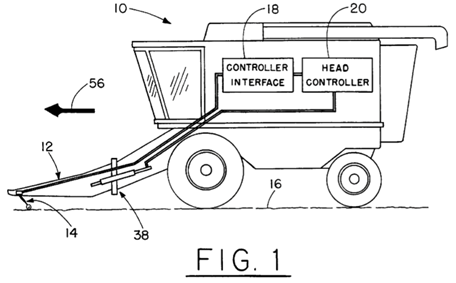
In this case, the claimed function was “raising or lowering the header in accordance with said first signal in maintaining the header a designated height above the soil,” as the parties agreed. The specification linked structure to a “controller interface 18,” “head controller 20,” and “hydraulic control system 38,” which are shown in following FIG. 1 of the patent. But the head controller’s description in the written specification mentioned that it controlled both height and lateral position of the header.
The District Court’s Analysis
In its two-step analysis, the district court correctly identified the claimed function as controlling header height. However, when identifying corresponding structure, it focused on the specification’s mention of lateral position controldespite this specific type of control not being recited in the claim.
The district court excluded the specification’s disclosure of the logic circuitry of Dial-A-Matic Version #1 as corresponding structure because it could not perform lateral positioning, even though that capability was not part of the claimed function. It then considered only Versions #2 and #3, which could control both height and lateral position. The district court found that these versions used programmed microprocessors to control height. This triggered the algorithm disclosure requirement under Federal Circuit precedent. However, the court held that the specification merely restates the function without providing real steps sufficient to be construed as an algorithm.
The Federal Circuit’s Analysis
First, the Federal Circuit agreed the district court properly identified the claimed function: raising and lowering the header to maintain height.
Second, the court considered corresponding structure. The Federal Circuit emphasized that means-plus-function limits cover only structure tied to the claimed function. Thus, the district court erred by disregarding the disclosed logic circuitry of Dial-A-Matic Version #1 as sufficient corresponding structure for the height control function just because it could not also handle the unclaimed lateral positioning function. Stated differently, the specification’s extra mention of lateral control should not disqualify structures that correspond to the height control function because lateral control was not a necessary part of the claimed function. Therefore, the district court erred by relying on an unclaimed function to reject otherwise sufficient corresponding structure for performing the actually claimed function.
The key mistake was rejecting Dial-A-Matic Version #1 as sufficiently disclosed structure. It was undisputed that Version #1 was commercially available at the time of the invention, and that it employed or included logic circuitry in the form of diodes and switches, not a specially programmed microprocessor, to control height of the harvester’s header. It was not necessary for the patentee to disclose the actual logic circuitry itself, so long as the commercially available Version #1 was sufficiently identified. As a consequence, and in view of uncontroverted expert testimony that Version #1 did, in fact, include such logic circuitry, the algorithm disclosure rule of 35 U.S.C. § 112(f) was not triggered.
Conclusion
Gramm reminds us that in means-plus-function analyses, focusing on the actually claimed function is paramount. Courts err when they import unclaimed functions from the specification, as happened here when the district court rejected Version #1 as a sufficient disclosure of corresponding structure merely because it could not perform lateral control in addition to height control of a harvester’s header. Patent drafters should clearly link structures to claimed functions without simultaneous description of additional functions that could later confuse a court. Keep descriptions of separate functions clearly separated. Litigators should emphasize that additional functional capabilities in disclosed embodiments do not limit disclosed corresponding structure where those additional capabilities are not specifically claimed. By reversing the indefiniteness ruling here, the Federal Circuit ensured that the patent claims are not invalid for failing a test they were never drafted to pass.
